Learn
How a Startup Should Choose Annual or Monthly Billing for Each SaaS Subscription

Updated: Nov 20, 2026
A startup should pay annually only for SaaS tools it is confident it will keep, at roughly the same seat count, for most of the coming year. Everything else should stay monthly. The annual discount is effectively the vendor paying you to give up your right to cancel or downsize, so the decision for each app comes down to one question: how certain are you about its usage over the next twelve months? ShiftControl approaches this from the operator's seat. Its founders scaled IT at ExpressVPN from 100 to 700+ employees across 7 global offices, and its spend module now tracks monthly and yearly cost per app, unused paid seats and upcoming renewals for companies running on Google Workspace.
TL;DR
- Treat the annual discount as the price of giving up flexibility. Annual discounts vary by vendor.
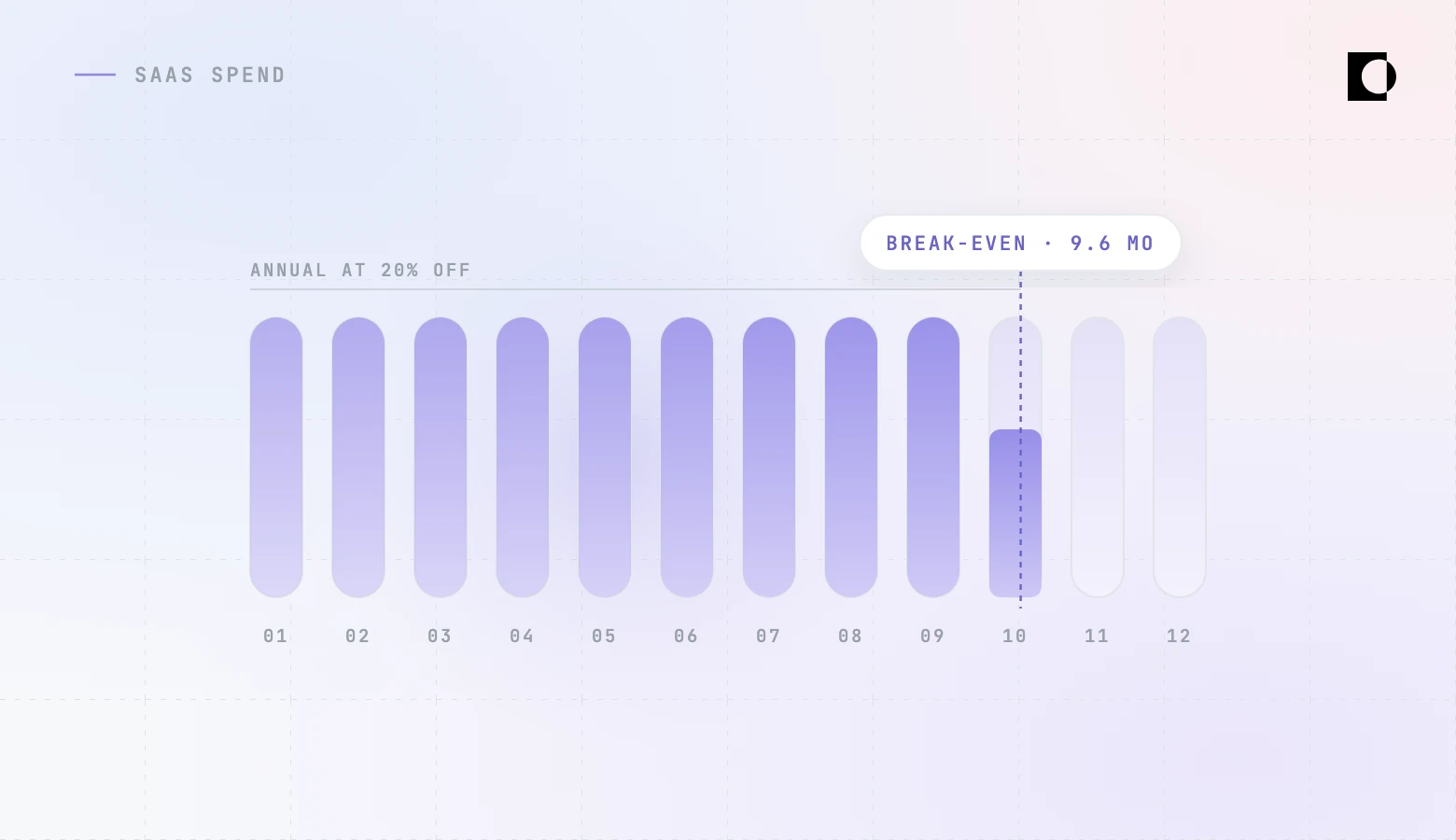
- At a 20% discount, a year paid upfront costs the same as 9.6 months of monthly billing (12 × 0.8). If you might drop the tool or cut seats before then, stay monthly.
- Go annual on systems of record, such as your HRIS, accounting and productivity suite. Stay monthly on experiments, single-team tools and anything tied to uncertain hiring.
- Decide app by app and revisit the choice at every renewal.
- You need per-app usage, seat counts and renewal dates in one view to make this call well.
About the Author: Written by the ShiftControl team. They are operators who ran IT at ExpressVPN through its scale-up and now build a SaaS management platform made for Google Workspace that tracks spend, seats and renewals for growing companies without requiring a dedicated IT team.
What is the difference between annual and monthly SaaS billing?
Price is only one of the differences:
| Factor | Monthly | Annual |
|---|---|---|
| Price per seat | List price | Discounted |
| Cash out | Small and recurring | Large and upfront |
| Exit | Cancel at the end of any cycle | Locked until renewal |
| Seat changes | Usually adjustable each cycle | Additions often allowed mid-term; reductions often wait for renewal |
| Admin | Twelve invoices a year | One invoice, one renewal date to watch |
| Your books | Expensed as incurred | Typically a prepaid expense, spread over the term |
The last row matters most for a startup with limited runway. An annual payment leaves your bank account all at once, even though it is spread across your P&L.
Why do SaaS vendors discount annual plans?
The discount exists because annual billing solves the vendor’s biggest problem, which is churn. Monthly billing creates more frequent cancellation opportunities than annual plans, since annual plans remove the month-to-month decision to cancel.
A useful way to think about the mechanism: monthly billing gives you an option to walk away every month. The annual discount is the vendor buying that option back from you. Selling the option is a good deal when you were never going to use it. It is a bad deal when there is a real chance you would have.
Which SaaS subscriptions should a startup pay for annually?
Following that logic, annual billing fits tools where your option to leave is close to worthless because you would not switch anyway:
- Systems of record: HRIS, payroll, accounting and your productivity suite. Migrating them is painful, so you will keep them regardless.
- Tools sized to a headcount you are confident about: company-wide tools where seat count tracks a stable team.
- Plans with extras on the annual tier: some vendors bundle support levels, security features or services only on annual plans. Compare features alongside prices.
- Proven tools: apps that have survived a trial or several monthly cycles and that people actually log into.
When is monthly billing the smarter choice?
The reverse case covers any subscription where the option to leave has real value. Stay monthly when:
- A team is still evaluating the tool, or two tools overlap.
- The tool belongs to one person or project that might end.
- Seat count depends on hires you have not yet closed.
- Runway is short and cash matters more than unit price.
- The vendor or product is early and changing quickly.
Seat risk is where annual savings disappear fastest. Take a hypothetical: you commit to 20 seats annually at a 20% discount but need only 15 for most of the year. You pay the equivalent of 16 full-price seats (20 × 0.8), which is more than 15 monthly seats would have cost.
How do you decide the billing term app by app?
Turning these principles into practice takes a short review for every subscription before its renewal date. This review is the core of SaaS subscription management:
- Inventory: list every paid app with its owner, seat count, billing term and renewal date. Include tools expensed on personal cards.
- Check usage: compare paid seats against active users. Flag seats still assigned to people who have left.
- Score certainty: will you use this tool in twelve months, and at what seat count?
- Run the breakeven: compare the annual price against the monthly price multiplied by the months you are confident about.
- Set the term and the reminder: note the contract’s cancellation notice window and calendar it well ahead.
- Re-decide at renewal: a tool that earned annual billing last year may not deserve it this year.
| Signal | Lean annual | Lean monthly |
|---|---|---|
| Switching cost | High | Low |
| Seat forecast | Stable | Uncertain |
| Recent adoption | Broad and steady | Patchy |
| Cash position | Comfortable | Tight |
How does headcount change affect the annual vs monthly decision?
A related but distinct question is what happens when the team changes size mid-contract. Growth and shrinkage both erode annual savings, through different routes:
- Growth: mid-term seat additions are often prorated at your contract rate, but they raise your renewal baseline.
- Departures: a leaver’s annual seat stays paid until renewal. If nobody removes their access, it often gets renewed too.
- Restructures: team-specific tools lose users when people change roles.
This is where SaaS license management and offboarding meet. ShiftControl suspends a leaver’s Google account on the HRIS termination date and lets finance reclaim Google Workspace licenses from suspended accounts in bulk, so those seats can go to new hires instead of being paid for unused until renewal.
What should you negotiate before signing an annual SaaS contract?
Since the annual commitment is the risky part, good SaaS contract negotiation focuses on reducing that risk. Before signing, ask for:
- The right to reduce seats at renewal.
- A cap on renewal price increases.
- Auto-renewal and notice terms stated clearly in writing.
- A monthly start with a path to annual pricing once adoption is proven.
- Quarterly or semi-annual payments on an annual contract to protect cash.
Vendors will not agree to everything. Asking is still a routine part of SaaS vendor management, and the weeks before renewal are when you have the most bargaining power.
Frequently Asked Questions
Is annual billing always cheaper?
Per seat, usually yes. In total, it is cheaper only if you keep the tool and the seats for most of the term.
What is a typical annual SaaS discount?
Annual discounts vary by vendor, so compare the actual quotes you receive.
Should early-stage startups avoid annual contracts?
Not entirely. Go annual on systems of record and stay monthly on tools that are still proving their value.
How do I track renewals across many subscriptions?
A spreadsheet works early on, but it drifts as people expense new tools. The best subscription management software, or dedicated SaaS spend management software, pulls cost, seat usage and renewal dates into one view.
Can I switch from monthly to annual later?
Many vendors let you upgrade to annual mid-cycle. Moving from annual back to monthly usually has to wait until renewal, so check the terms.
Does ShiftControl offer monthly and annual billing?
Yes. ShiftControl publishes a standard per-user price and runs a separate discounted program for eligible startups. There is a 14-day free trial with no credit card required. On annual Core and Enterprise plans, the subscription includes 24/7 Blackpanda incident response.
About ShiftControl
ShiftControl is a SaaS management platform made for Google Workspace, built for operators, not IT teams, and designed so no dedicated IT team or IT hire is required. It replaces four tools and a spreadsheet with one platform covering provisioning and access, SaaS spend management, app-permission visibility and incident response, with IR-1 from Blackpanda included on annual Core and Enterprise plans. Its spend dashboard shows monthly and yearly cost per app, unused paid seats and upcoming annual renewals, which turns the billing review in this article into a quick routine. Setup takes about 30 minutes through a single Google Workspace login, and ShiftControl is SOC 2 compliant.
To see your own subscriptions, seats and renewal dates in one place before your next contract comes up, visit ShiftControl and start a free trial.
References
Get started
Experience SaaS management as it should be: straightforward management and robust security with ShiftControl.
Start free trial